
Internet Biologists - Zoo de Thoiry
Profile
Internet Biologists (I.B.) is currently a non-profit independent international platform for the advancement of biological sciences and academic scholarship through the Internet.
Since 1996, we strive to foster virtual connections between Biologists at disparate locations, provide training opportunities for research scientists with the integration of Internet tools into their research, and provide networking and mentoring opportunities for the international Biological research community.
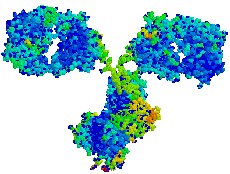
Network of Collaborators
A worldwide network of collaborators in academia and industry is available to participate and assist with the new projects on volunteer basis. Active contributors to extend the I.B.'s research capabilities are always welcome.
Systems Collaboration
Through specialized projects (B.R.I., D.B.R.I., V.I.W.B., V.R.M.L....) I.B. promotes tool development for education and visualization of biological models in addition to biological collaboration between different groups on the internet. Discussion groups are initiated and innovative solutions and models are offered.
Research Ideas
Research efforts are driven by the need to fill the gaps of resource scarcity in local bioscience communities around the world.Through collective minds and ease of access to a variety of research tools, most of the I. B. participants and consultants today, continue their virtual union and benefit the informal guidance towards individual research solutions.
About Us
Internet Biologists includes Academic Advisors who assist IB to bridge virtual initiatives with established academic and research institutions and to monitor the scientific content of IB, a Technical Team which includes specialists with extensive experience in the field and a group of Administrators pioneering online innovations with exceptional emulative value for Internet Biologists.Click here to read the progression of I.B.
Articles by the founder Chin Hoon Lau: First Two Years, In Search of Permanency.
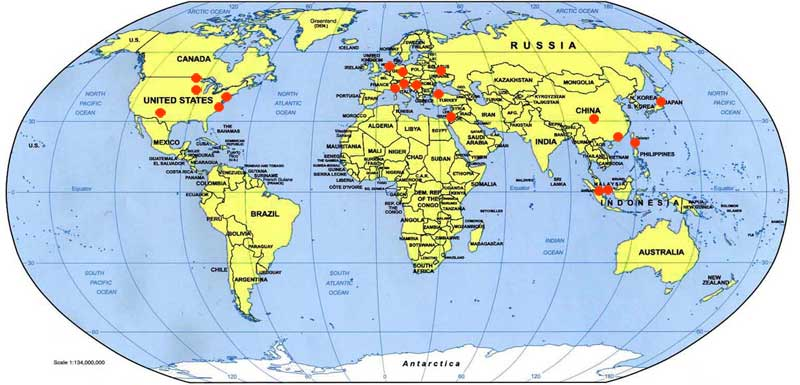
Biologists in the academia and industry around the world collaborate to expand research resources and share solutions. Red dots on the map show the location of some of the current and past I.B. participants. See the full members list.
Links
The following web sites are valuable resources for Distance Learning and Research Collaboration platforms for Bioscientists on the Internet. We would appreciate to hear about your recommendations for other related sites.
- VSNS, Virtual School of Natural Sciences: The Virtual School of Natural Sciences BioComputing Division (VSNS-BCD) is offering educational services over the Internet, in the area of Biocomputing /Computational Biology / Bioinformatics.
- GNA, Globewide Network Academy: Globewide Network Acdemy is an educational non-profit organization serving as a portal to over 20,000 courses and affilitated programs offered on the Internet.
- Zoo de Thoiry
- VHG, Virtual HyperGlossary: VHG aims to provide a "terminological environment" for any document for increasing knowledge creation and retrieval on the Internet. The organization offers consulting and partnership.
- OnLine Biology Book: A glossary of biological terms with pictures.
- Cell & Molecular Biology Online: Pamela Gannon's site lists gateways to useful online resources for instructors, students and people looking for general biology information and other links for online research tools.
- DIY, Do it Yourself Search: David Atherton's advanced search tool for biology.
- Spectrum Virtual University
- Cloud Forest Institute
- Science's Next Wave
- The Glycoscience Network
IB Members
Affilitations
Specialty and IB Contribution
Valerio Aimale M.D. | School of Medicine, The University of Genoa, Italy / Italian Linux Society | Administrator, linux.it mailing lists
Tomaz Amon, Ph.D.
more.. | VRML Consultant, Slovenia | Biological VRML simulation
David Atherton, M.Sc. | Technician, Texas A&M; | System administration and operation, IB-Chair(2000)
Nico van Belzen, Ph.D. | Centre of Expertise Nutrition, DMV International / Campina Melkunie, The Netherlands |
Sally L. Benjamin, M.Sc., JD
more.. | President, Professional Regulatory Outsourcing, Inc., USA | Environmental regulation, field biology and public dispute resolution
Patrick M. Burnstad | Executive Director, Cloud Forest Institute / Globewide Network Academy / Learning Corp., Inc., USA | Distance education and virtual team management
Joe Carnwath, Ph.D. | Staff Scientist, Biotechnology Department of the Institut fur Tierzucht und Tierverhalten (German Ministry of Agriculture) |
Len Farber, Ph.D. | Information Analyst, EDS, Chicago Solution Center, USA / Instructor, Institute for Professional Development, School of Computer Science, Telecommunications and Information Systems, Depaul University, Chicago, Illinois, USA | Co-coordinator, BRI (4th edition)
Christian Frosch, Ph.D.
more.. | Institute of Toxicology, University of Mainz, Germany | Coordinator, BRI (4th edition),
IB-Chair(1998)
Georg Fuellen, Ph.D.
more.. | Investigator, Integrated Functional Genomics, IZKF, Germany | Founding advisor, BRI, Distance training, Biocomputing
Siowck Lee Gan, Ph.D. | Associate Professor, Institute of Distance Education, Universiti Putra Malaysia, Malaysia | Instructional design, course evaluation
Steven Gendel, Ph.D. | Chief, Biotechnology Studies Branch, Center for Food Safety and Applied Nutrition, Food and Drug Administration, USA | Instructor, DBRI
Farid John Ghadessy, Ph.D. | Dept. of Obstetrics and Gynecology, National University Hospital, Singapore |
Gustavo Glusman, M.Sc.
more... | Founder & Administrator of BioMOO, Weizmann Institute of Science, Israel | BioMOO Administrator
Takashi Gojobori, Ph.D. | Director and Professor of Center for Information Biology, National Institute of Genetics, Japan | Academic Advisor
Robert E. Gore-Langton, Ph.D. | Information Specialist
The EMMES Corporation
Potomac, MD, USA; supporting NCI projects at the NIH, Bethesda, MD | Co-coordinator, DBRI (2nd Edition), Perl Course Administrator, IB-Chair(2001)
Ralf Hofestaedt, Ph.D. | Professor at Otto-von-Guericke University of Magdeburg, Germany | Academic Advisor
Srikanth Jammulapati | Sequence Analyst, Myriad Genetics, Inc., USA | Consultant
Hoon Eng Khoo, Ph.D. | Vice Dean, Faculty of Medicine, National University of Singapore, Singapore | Academic Advisor
Nils Koester | Biocrawler, Germany (Associate Sponsorship) | Technical Team
Oi Lian Kon, MB, B.Sc., MD more.. | Head, Molecular Medicine Laboratories, National University of Medical Institutes, Singapore | Academic Advisor
Pinar Kondu, M.Sc. | Bioinformatics Scientist, Iontek Inc., Istanbul, Turkey | Instructor, BRI (1st edition), Technical Team member, Graphics and Web site design and editing, Perl Course Instructor, IB-Chair(2002-present)
Sophia Kossida, Ph.D. | Director of Bioinformatics, Endocube, Toulouse, France |
Consultant, BRI, Coordinator, DBRI
Chin Hoon Lau, M.Sc.
more.. | President, Lagenda Knowledge Systems, Malaysia (Associate Sponsorship) | Founder, and IB-Chair(1996-1997) Coordinator, BRI (Editions 1, 2 & 3), Coordinator, Virtual Teaming and Professional Development
Zev Leifer, Ph.D.
more.. | Professor of Microbiology, New York College of Podiatric Medicine, USA | Academic Advisor, Perl Course MOO Administrator
Hwa A. Lim, (HAL) Ph.D.
more.. | Founder and CEO, D'Trends, Inc., USA | Academic Advisor
Ofer Markman, Ph.D. | Co- founder and VP New technology Development Procognia Ltd., Israel | Founder of VIWB
Sock Hoon NG, B.Sc. | Defense Medical Research Institute, Singapore | Research Officer
Heladia Salgado Osorio | Laboratory of Computational Biology, Nitrogen Fixation Research Center (CIFN/UNAM), National University of Mexico, Mexico | Instructor, BRI (1st edition)
Govindan Parayil, Ph.D. | Senior Assistant Professor, Division of Social Science, The Hong Kong University of Science and Technology | Knowledge development, Research Consultant
Rebecca Parsons, Ph.D.
more.. | Assistant Professor of Computer Science, School of Computer Science, University of Central Florida, USA | Academic Advisor
Michael Rebhan, Ph.D. | Project Leader Bioinformatics Institute, Singapore | Virtual Teaming and Professional Development, Instructor and coordinator, BRI (3rd edition)
Nicole Ruediger, M.Sc. | Science's Nextwave, USA | Technical Team member, Organizer of Virtual community of scientists
I. Richard Schaffner, Jr., P.G. | Technical Specialist, GZA, GeoEnvironmental, Inc. / Moderator, Bioremediation Discussion Group, USA | Technical Team member, Mailing list management
Wendy Sekovich | Director, Global Outreach Program, Virtual University / Global Online Learning Community, USA | Technical Team member, Website development, online community
Marek Skrzypek, Ph.D. | Proteome Databases Senior Editor, Functional Genomics, Proteome Division, Incyte Genomics, USA | Co-Instructor Perl Course
WeiChen Tien, Ph.D. | President, Development Center for Biotechnology, Taiwan | Academic Advisor
Fu Jun Wang, M.Sc. | Deputy General Manager, QA Manager, ZheJiang HanSheng Pharmaceutical Co. Ltd, PR China | Instructor, BRI (1st edition)
Eva Young, M.Sc. | Policy Librarian, University of Minnesota, USA | Coordinator, DBRI, IB-Chair(1999)
Yongyuth Yuthavong, Ph.D.
more.. | Director, National Science & Technology Development Agency (NSTDA), Thailand | Academic Advisor
Join Us
Internet Biologists is a unique platform for professional development in both biological sciences and distance education. We always seek new members who can:
contribute to existing projects with scientific, academic, technical and administrative support, editorial, graphics, website development, publicity etc.
initiate a new course or collaboration program (proposal required)
Please write a self-description including your name, affiliation, contact information and research interests and send it to pkondu@yahoo.com